The grave of Soren Kierkegaard (1813-1855), Assistens Cemetery, Copenhagen, 14 May 2017.
That’s actually how I’m treated here in Copenhagen. I’m looked upon as a kind of Englishman, a half-crazy eccentric, with whom let’s all of us, notables and street urchins alike, imagine we can make sport. My writing activity, that enormous productivity whose inner pathos I’d have though could stir stones, and which in some areas none of my contemporaries can match, let alone the whole–all of this is looked on as a kind of passion, like fishing and so on.
Soren Kierkegaard, Papers and Journals: A Selection, ed. & trans. Alastair Hannay, Penguin: 1996 [1848], 48 IX A 288.
Two recent releases, both directed by Christophe Rousset with Les Talens Lyriques:
Farinelli, Ann Hallenberg with Christophe Rousset and Les Talens Lyriques (Aparte, AP117).
This concert, recorded in Bergen in 2011, includes works the eighteenth century castrato Farinelli performed by Hasse, Leo, Giacomelli, and the singer’s brother, Riccardo Broschi. (Hallenberg makes Broschi’s Ombra fedele anch’io, from the 1730 opera Idaspe, with its long, lilting line, sound effortless.) There are also three works by Porpora, including the great Alto Giove, all sung with the same beauty you find in Phillippe Jaroussky’s Farinelli: Porpora Arias of 2013. The bonus is two major works by Handel—Lascia ch’io pianga and Sta nell’Ircana—which Farinelli did not sing but who is criticising; here as elsewhere, Hallenberg and Rousset can do no wrong.
Nicolai Abildgaard (1743-1809), Ossian Singing his Swan Song (detail), 1780-1782, National Gallery of Denmark
Uthal by Etienne-Nicolas Méhul, Christophe Rousset with the Choeur de Chambre de Namur and Les Talent Lyriques, (Palazzetto Bru Zane and Ediciones Singulares, ES1026).
Méhul’s one act opera of 1806 was inspired by Ossian (and poems David Hume had already picked as forgeries thirty years earlier), all dark and misty Scotland from an orchestra without violins. There’s splendid singing throughout in this work, including a beautiful Hymne au sommeil and Karine Deshayes, spectacularly dramatic as Malvina in Morceau d’ensemble No. 2, Le grand Fingal. With Malvina’s intercession, her husband Uthal is forgiven by her father for treason and all ends well—‘o joie, o bonheur, plus de larmes oublions les jours du mal’. It’s a fascinating reconstruction from the beginning of French Romanticism.
Asne Seierstad’s One of Us: The Story of a Massacre and its Aftermath is justly acclaimed, harrowing but always clear-sighted. Was Breivik responsible? Given the enormity of what he did, it’s not surprising that the two groups of psychiatrists appointed by the court differed in their conclusions: the first found him to be psychotic and therefore not responsible for his actions; the second that he had a dissocial personality disorder and was responsible. But the book convinces me that, as the court decided, Breivik was accountable.
Seierstad reports that a prison psychologist, Eirik Johannessen, had frequent sessions with Breivik during his trial and saw no evidence that he was psychotic; he was, for example, able ‘to see himself from the outside’ and moderate his behaviour in the courtroom. Rather, Johannessen concluded that:
‘Breivik’s ideas were an expression of extreme right-wing views, and the way in which he presented them could be accounted for by his inflated self-image’
(Asne Seierstad, One of Us: The Story of a Massacre and its Aftermath, trans. Sarah Death, London: Virago, 2015, p. 474)
Breivik was a liar and a failure, not mad. But there are better ideas for the world. What Seierstad does so well is to show us the people who died at Utoya in 2011, their vitality and their hopes.
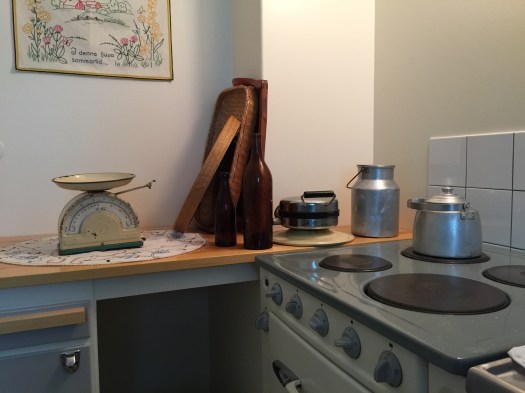
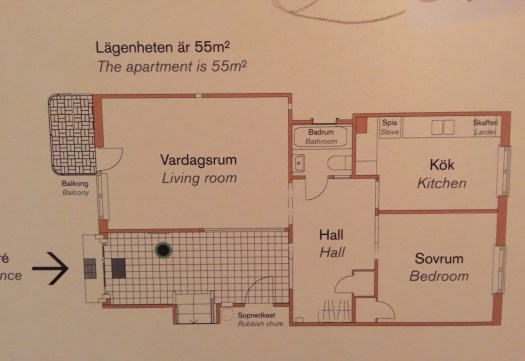
The Nordiska Museet reconstructs a Stockholm appartment from the late 1940’s, the period when the Swedish Welfare State aimed ‘to build good, functional housing at reasonable cost’. It’s light, spacious-feeling (though with only one bedroom so there are beds tucked away everywhere) and a great advance; families left single-room, cold-water appartments to move into these places. Appartment blocks can have their own problems and one shouldn’t be too sentimental, but this was a remarkable shift in the way people lived.
So, what happened to that goal of decent and affordable housing? Everywhere?
Josef Frank: Against Design, at the Swedish Centre for Architecture and Design (at the Moderna Museet in Stockholm) until 27 August and before that at the MAK in Vienna, could be read as the story of the man who brought idiosyncrasy and brightness to Functionalism. But against design? Hard to see in someone who claimed that:
‘I build on a cultivated tradition, I have saved Swedish interior design and created the Scandinavian style. Before me the only traditon was Bauhaus.’
(quoted in Hedwig Hedqvist, 2015, Josek Frank, Swedish Architects and Designers, Orosdi-Back, p. 34)
Hard to say whether it was the Scandinavian style but what he made had great flair. Nearly a century later, the fabrics (if maybe not all of the furniture) look tremendous.
Josef Frank, Tang 1925-30 for Haus & Garten, Vienna and later Aristidia, for Svenskt Tenn, Stockholm
And though this might have been sold on Strandvagen, it was actually designed earlier in Vienna. Neither design nor geography seem entirely helpful notions here; but the work is great.
Why start this blog? Because I want to find a voice here: to speak to my friends in words and images about art and literature and life; and to move outside myself, to give shape to my experiences and share them. And, equally important, to listen.




 Looking, Thinking, Falling Over